
I like to think Frida Hansen would be pleased at the number of workshop attendees in the U.S. (and Norway!) who are learning about her life and work — and taking inspiration to create their own transparent tapestries. In each workshop I hope the students are as fulfilled as I am, as I absorb their enthusiasm and creativity. It is especially fun to receive photos of transparencies that were started in the workshops.
Maddie Tsurusaki attended the Tucson workshop, and recently completed her piece. She noted, “At the top I did a half damascus edge and wove the warp ends up into the tapestry. It worked but was time consuming.” She shared photos of the tapestry against two different walls. In this technique, with the wall peeking through open warps, the effect can be so different, depending on the color behind.


Also from Tucson, Joan Sumpkin probably won the “most experimenting on the loom” award. She began her design based on a fireplace screen in her home. I think she really enjoyed seeing and playing with the shapes, and she wasn’t afraid to change her mind as she went. Her cartoon was just a suggestion. By the time her transparency was finished, she had even added a Frida rose to the center.


Betty Headrick (Tucson) finished her workshop transparency. I love the bars of almost random lengths, in varying colors, in her borders.

Katherine Buenger (Milwaukee workshop) wove a water lily for her first piece. Her second transparency is a colorful chicken! Katherine wrote, “I am really enjoying this technique. I have grand plans for how am going to finish my chicken. Here it is on the loom. If my plan works I will share with you all.”


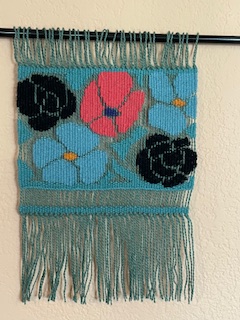
Lynn Breckenridge (Tucson) sent two photos of her transparency. She wrote, “The first photo has the weaving against a wall with light on the front and the woven areas are in color; in the second photo the weaving is moved in front of a glass door with daylight shining from behind (the woven areas seem black.” Note that she wove two of her roses in black. They are dramatic and balance really well.

Extra credit to Sara Batchelder (Tucson) who documented her workshop experience with a video. I am sharing this now, even though we will have to wait to see her finished tapestry with a wolf peering out of the foliage. See Sarah and her inspiration photo below; watch the video here.


Connie LaTendresse (Milwaukee workshop) surrounded a daisy with woven bars and stripes. It’s so interesting how much variation you can achieve with squares and bars of different lengths and colors.

Peggy MacArthur (Milwaukee) wove a black cat from a Japanese woodcut print. The vase was merely a shape in the original; Peggy added the flowers and the marvelous wallpaper.

You can read about the problems Patricia Jens (Milwaukee) encountered during her weaving (here), but the resulting tapestry of her daughter’s silhouette on a beach worked out marvelously. Her stash yarn became wonderful waves.

Cindy Owen (Milwaukee workshop) wove lovely open veining in her trillium blossoms.

Wendy Gilmore, who attended the Conference of Northern California Handweavers workshop, recently completed a lovely bird and flower composition, after healing from a shoulder fracture. Perhaps this tapestry technique was the best type of weaving during recovery; it doesn’t require banging threads on a loom like some other techniques.


The only thing more fun than sharing these completed workshop pieces is knowing that there will be more in the future. I’ll share more soon.