
I have an idea about how Frida Hansen came up with her wool open warp transparency technique. It occurred to me on a visit in August with Frida Hansen’s great-grandsons at Bestumhus, Frida Hansen’s home. The family owns one of Hansen’s early tapestries, Havfruedans [Mermaid Dance], woven in 1896. What a delight it was to see it in person.
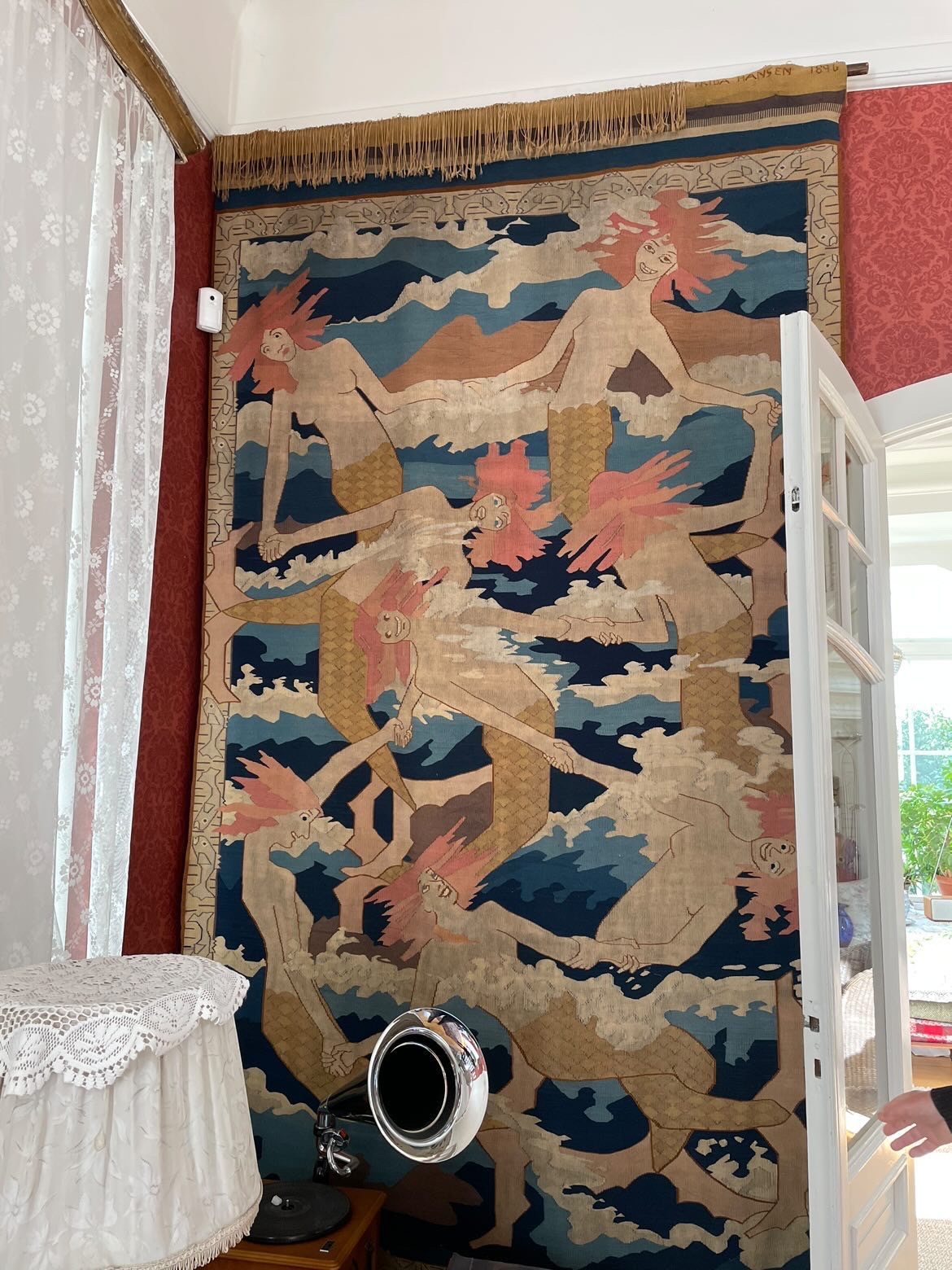
It was the mermaid scales that caught my eye — how there seemed to be a feeling of open space between them.


I remembered my close study of two versions of Frida Hansen’s mermaid transparent tapestry, one at the Stavanger Art Museum and one at the Stavanger Public Library. In those the mermaid scales are definitely divided by open warp.


Did her work with defining mermaid scales in Mermaid Dance in 1896 lead to experimentation with expanding open spaces in tapestry, and to finding just the right material — wool — to make more and larger spaces possible? That’s my theory.
How Frida Hansen came to develop her wool open warp technique: a theory
Frida Hansen didn’t even learn to weave tapestry until 1889. Eight years later she was creating tapestry as monumental and accomplished as Melkeveien. She learned from her first tapestry, Birkebeiner Soldiers Smuggling Haakon Haakonson Over the Mountain, that she needed to evolve her images to work with the medium of tapestry. She spent an intense decade experimenting with image and technique to find her way to a personal artistic vision and execution.


Experienced tapestry weavers know that even slight variations in tension when switching directions at the edge of a color can change the look of the tapestry. If the yarn is left too loose when turning the corner, an unsightly bump may occur. With attention and experience, tapestry weavers learn the perfect tension to create a flat, beautiful textile. But there’s a third way. If you tug the yarn as you change direction, a small hole will appear. Frida Hansen might have mused along these lines (I’m putting words in her mind!)…
“OK. I’m weaving these mermaid scales. If I weave them separately with this beautiful yarn with variegation, they will stand out from one another. Oh, I know. If I tug the yarn slightly when I am turning, it leaves a nice hole. That’s a good look. And I can add another wrap around a single thread to leave some more space. I wonder what would happen if I leave even more space between the sections. No, wait. That’s not going to work on cotton or linen warp. It will just slide right down.
“I know. I’ll try wool for the warp.”
I imagine her experimenting, warping a loom with wool and weaving the pattern with warp left open. Perhaps she took the piece with open warp off the loom and shook it a bit, marveling that the images stayed in place, with the tiny hooks of the wooly warp and weft fibers clinging together. Holding it up to the light, she may have marveled at the shapes created by the woven and unwoven areas.
Here’s another imaginary Frida Hansen thought, thinking about a use for the technique.
“Everyone likes a lace curtain these days, filtering the light. This will be even better, and with color and pattern!”
It is unknown how – and why – Frida Hansen came up with this technique. The tapestries she had created to that point all showed an increasing degree of technical mastery and constant experimentation. The transparency technique could have been the result of working to create varying and decorative areas in the large pictorial tapestries. In the tails of the mermaids in Mermaid Dance, the openings between the scales create a decorative pattern. From this technique it would not be a long stretch to allow the design to be created by weft inlay on open warp threads. Frida Hansen’s initial idea can also have come from a desire to transfer the open effects in lace and tatted curtains to weaving.
The openings left by unwoven warp became the “open ornamentation” she described in her patent.
I came up with these ideas–I thought–on my own. But when I re-read Anniken Thue’s biography of Frida Hansen, I saw that she already came up with a similar theory. Thue wrote in her book, Frida Hansen: En Europeer i Norsk Tekstilkunst (Frida Hansen: A European in Norwegian Textile Art (Oslo : Universitetets forlag, 1986):
“The transparency technique could have been the result of working to create varying and decorative areas in the large pictorial tapestries. One example is the tails of the mermaids in Mermaid Dance, where the kelim-openings create a decorative pattern. From this technique it would not be a long stretch to allow the design to be created by weft inlay on open warp threads.”
No doubt I first read that passage years ago. The idea might have been in the back of my brain, but it felt like a new revelation when I saw Mermaid Dance in person for the first time on a magical visit to Frida Hansen’s house, Bestumhus, last August.


